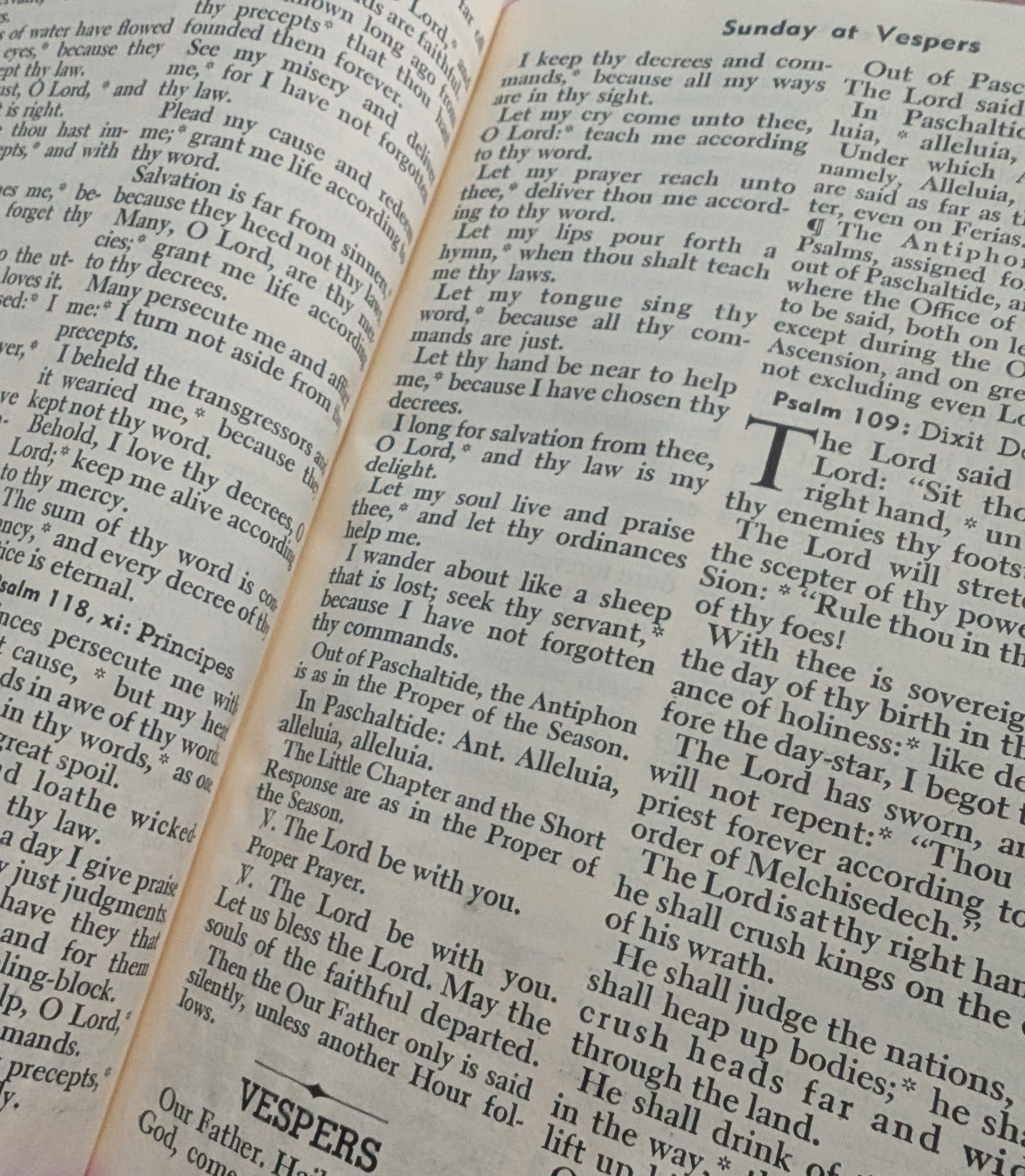
Sometimes prayer comes easily, and sometimes it feels impossible. There are days when I cannot find the right words — or any words at all — to speak to God. Yet even on those days, the Church gives me the words to express thoughts and longings that I would otherwise struggle to voice.
I sometimes have the privilege of assisting at a Traditional Latin Mass as a straw subdeacon. As I prepare to serve, I often feel a mixture of awe, hyper-focus on the task at hand, and human distraction. In those moments, when the heart feels too full or the mind too scattered, the Church provides the answer: Introibo ad altare Dei — ‘I will go to the altar of God.’
This simple yet profound line sets the tone for everything that follows. Even when I feel uncertain or overwhelmed, the ancient prayer places me where I need to be: in the presence of God, guided by the words of countless generations before me.
The Psalms offer an especially rich treasury for the soul that struggles to pray. Whether it is a confident ascent to the altar or a desperate plea from the depths of confusion, the Psalms give voice to every part of the human experience.
“I wander about like a sheep that is lost; seek thy servant, because I have not forgotten thy commands.” (Psalm 119:176)
When I find it hard to pray, I have learned that I do not need to invent new words or force emotions I cannot feel. Instead, I can step into the prayers already given — ancient, tested, faithful. The Church, through the Psalms, lends me her voice when mine falls silent.
There is a great consolation in realizing that even my inability to pray is not unique. In the Psalms, I find companions who have struggled, wept, rejoiced, and hoped across centuries. When I turn to their words, I am no longer praying alone.
In those quiet, difficult moments, the Church reminds me that prayer is not something I must achieve; it is something I can receive — carried on the voices of the faithful, reaching out across time.
Leave a Reply