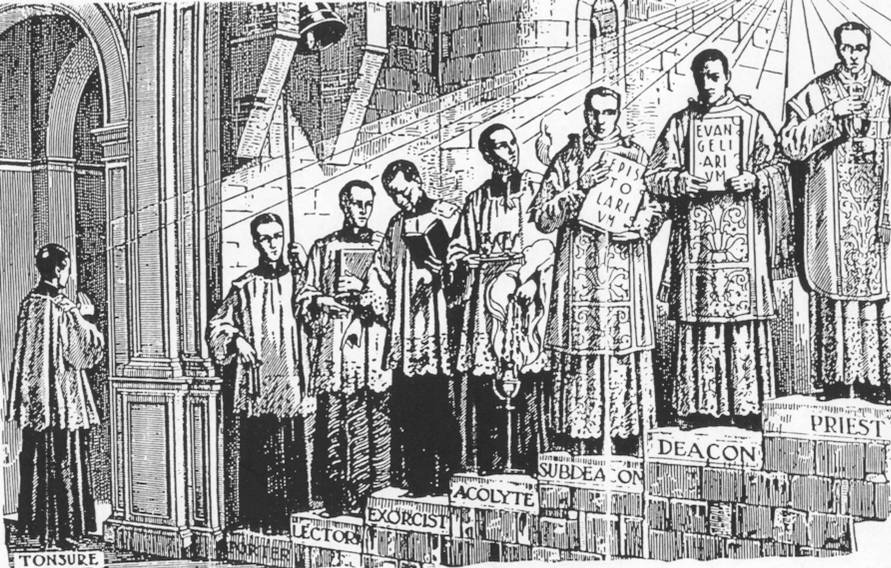
Paul VI’s new order of Mass went into effect on the First Sunday of Advent, 1969. At that time, there were still three major orders in the Catholic Church: Priest, Deacon, and Subdeacon. The office of the Subdeacon was not formally suppressed until January 1, 1973. For about two years, there was a curious overlap, the new Missal was in use, yet the Subdeacon remained.
It has always been a great matter of curiosity to me what role the Subdeacon had in the revised Mass. It is often assumed that the Subdeacon must have had little or no responsibilities in the Novus Ordo. However, this is not the case. While his role was not as pronounced as in the Traditional Latin Mass, the Subdeacon had distinct and meaningful duties in the early Ordinary Form.

Duties of the Subdeacon in the Early Novus Ordo
According to the 1969 General Instruction of the Roman Missal (GIRM), the Subdeacon’s role included:
– Assisting the Deacon or the Priest as needed (GIRM 142).
– Proclaiming the Epistle or the reading before the Gospel from the lectern (GIRM 142, 145).
– Preparing the altar and sacred vessels (GIRM 65).
– Carrying the cross between two ministers with candles in procession or alternatively he could carry the gospel during the entrance procession (GIRM 143).
– Making reverence at the altar alongside the Priest and Deacon he goes up with the Deacon and Priest and kisses the altar. The subdeacon also assisted during the incensation if incense was used (GIRM 144).
– Assisting the Deacon during the proclamation of the Gospel (GIRM 146).
– Preparing the altar during the Offertory while the Deacon and Priest remained seated, and pouring the water into the chalice (GIRM 147).
– Standing near the Priest during the Eucharistic Prayer and assisting with the Missal when necessary (GIRM 148).
– Receiving the Sign of Peace after the Deacon and offering it to nearby ministers (GIRM 149).
– Receiving Holy Communion under both kinds after the Deacon (GIRM 150).
– Assisting the Deacon with the purification and arrangement of vessels after Communion (GIRM 151).
Additionally, the Subdeacon vested distinctly in an alb, amice, cincture, and tunic (though the tunic could be omitted for less solemn occasions).
A Distinct Ministerial Role
It is notable that the Subdeacon’s role was structurally distinct, not merely a lay function. When a Subdeacon was present, certain tasks were reserved to him alone. Laymen could not substitute for the Subdeacon (GIRM 70). There was no such thing as a “straw Subdeacon” in the Novus Ordo.
The Subdeacon’s proper proclamation of the Epistle maintained a beautiful distinction among the ministries of the Mass:
– A lector proclaimed the first reading.
– A cantor or choir sang the psalm.
– The Subdeacon proclaimed the second reading (the Epistle).
– The Deacon proclaimed the Gospel.
Each role had a clear and meaningful identity within the liturgy.
The suppression of the Subdeaconate blurred these carefully ordered distinctions. Today, many duties once proper to specific ministers are either handled by laypeople or absorbed into the general flow of the Mass without clear differentiation.
Unfortunately, the days of the subdeacon were numbered once the council began. With plans of his elimination floated to the Consilium as early as 1965.1 His days coexisting with the Novus Ordo were the curious result of the reform of the non-sacramental orders taking a little longer than the reform of the Mass.
UPDATE:
In a later post I look at how Ministeria Quaedam reassigned these very functions to primarily the deacon, and then the instituted ministries of lector and acolyte, and then, in practice, to lay readers and altar servers. See Where did the Subdeacon’s Duties Go.


Leave a Reply to An AcolyteCancel reply